Full transcript
[00:00] BRENT: When people are going to live longer, it's also really important that they maintain their confidence. If you live to 110 but your skin looks 150, that's not a great equation for someone. We need to have skin science keep up with biological science.
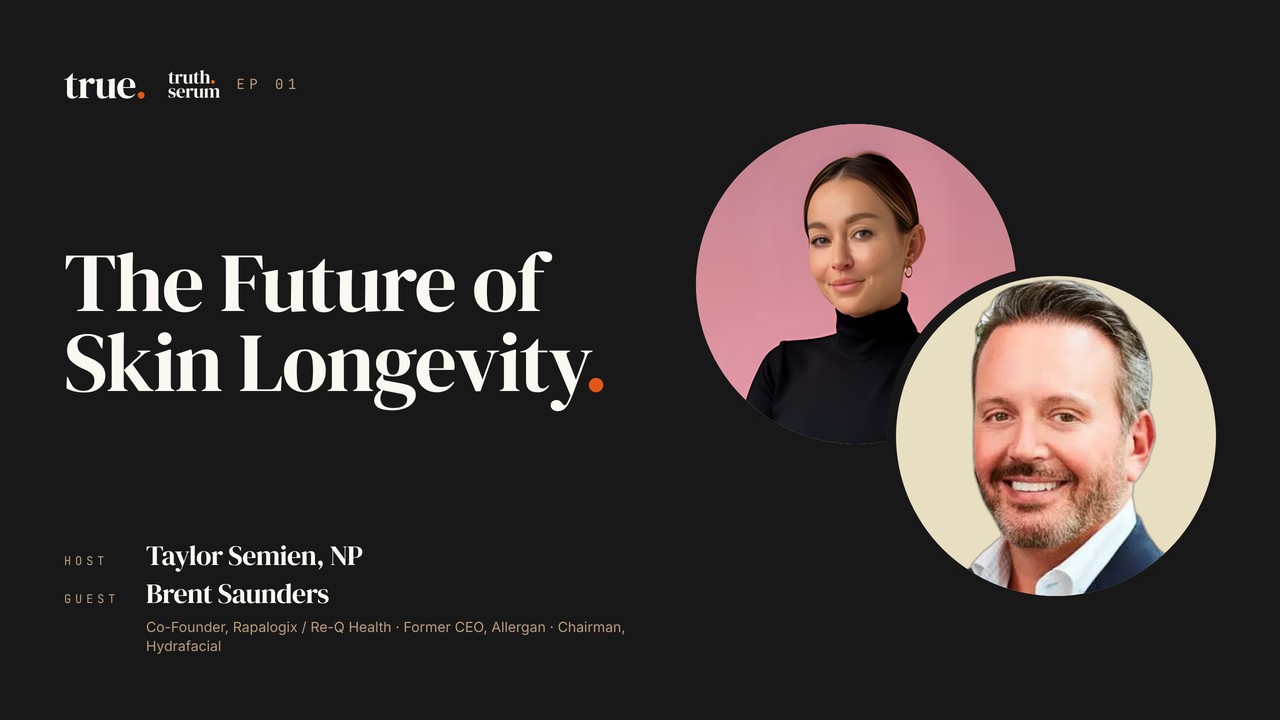
[00:27] TAYLOR: Everybody, I am Taylor Semien, co-founder of True Aesthetics, and I have Brent Saunders with me today. He is the CEO of Bausch + Lomb. Give us a little background in aesthetics and how you landed with Rapalogix.
[00:52] BRENT: I've been in the aesthetics world about 10 or 11 years. My introduction came through my role as chairman and CEO of Allergan. neurotoxin was our lead franchise and probably one of the most popular aesthetic treatments today by brand. After Allergan I got involved with Hydrafacial and remained chairman of that company. In between Allergan and Bausch + Lomb I started Rapalogix, focused on cellular science and pro-longevity — not anti-aging, but pro-longevity — looking at how we could delay cellular aging in skin. It was a science project for a number of years before it became a product.
[01:56] TAYLOR: You've seen aesthetics go from only neurotoxin to a lot of regenerative treatments. How did aesthetics land in wellness, and now longevity, where it's no longer just aesthetics?
[02:21] BRENT: A lot of it has to do with science. Science always has an evolutionary pathway. When Allergan launched neurotoxin, that was pretty high science — like the cell phone, revolutionary when it came out. As science evolved and we gained a better understanding of genetic and biological data, the longevity field emerged. It started decades ago, but the science has evolved much more radically over the last few years. I'm optimistic about where it's going: better treatments that help people look their best as they age, and people will live longer. Maintaining your skin is an important part of the longevity equation.
[03:47] TAYLOR: I'm seeing that in my clinics too. We want to be backed by science for safety, and we're thankful for companies like Rapalogix pushing that forward. Consumers are so much more savvy now — they don't just want to look better, they want help aging better. Since bringing Re-Q into my clinic, after people's first eight weeks or so they're starting to see external benefits. Pair that with the internal science we're all still working on — we don't have it all figured out on the longevity side — but the science and the consumer are going to force us to do the research and figure out how to age better.
[04:49] BRENT: It's amazing that the people coming into your clinic are thinking that way. But that population is biased toward seeking professional help. A massive number of consumers don't access the field that way — they access it through traditional marketing, big multinational brands, TikTok, Instagram, Facebook. They see marketing hype and never digest the science. Your patients are probably a skewed version of people who really want to talk to a professional.
[05:46] TAYLOR: We do see it on Instagram and TikTok — peptide skincare, for instance. I appreciate the science, and Re-Q and Rapalogix are so much more than a peptide mimicking something in a skincare product. It's our job as clinicians to educate the consumer on what longevity and skincare really is, not just anti-aging.
[06:21] BRENT: I couldn't agree more.
[06:24] TAYLOR: Where do you see this market heading over the next three to five years?
[06:41] BRENT: It's multifactorial — a lot of things are converging at once. Consumers are becoming savvier. They want to live longer; the general longevity space is taking off, even though there are still a lot of ambitious claims being made. People understand the holy grail of a long life is eat well, sleep well, and exercise. Diagnoses that were untreatable are becoming chronic or curable, so people will live longer. What still has to be solved is this: when people live longer, it's important they maintain their confidence. If you live to 110 but your skin looks 150, that's not a great equation. We need skin science to keep up with biological science, and I think that happens over the next couple of years. Products like Re-Q are a first start — patients notice a physical benefit around eight weeks, but what they don't see is what's happening to their fibroblasts. That reset benefits you for decades, but you can't wind the clock forward and compare. So we have to keep generating evidence and data in a way a consumer can understand or a professional can easily explain.
[09:07] TAYLOR: I worry, because the mainstay of aesthetics has been before-and-after. With neurotoxin, people can see it wear off and go back. When you're maintaining your fibroblasts, that benefit is hard to experience in a before-and-after picture. Technologies that can show what's happening at a cellular level are really important — hopefully there are advancements even in punch biopsies.
[09:54] BRENT: I've seen a lot of startups with great science working on better diagnostics for skin. Like all parts of healthcare, diagnostics have to evolve, and aesthetics has never really had a big focus on diagnostics until recently. It's exciting to see that develop, particularly in venture-backed and early science companies.
[10:19] TAYLOR: You've built and backed a ton of category leaders. What about the pattern of Rapalogix and longevity as a whole says it's a true inflection into the market and not just hype? On social media people assume it's trending. We see the true value — and the longevity of the market. This isn't going anywhere.
[10:58] BRENT: Strategically, the two most important things we're doing with Re-Q at Rapalogix: one, focusing on the professional channel — not retail for now — so professionals experience the product with their patients and we provide them the data and the science. Two, it's our responsibility to generate more science, continue to support Re-Q, and develop more products based on TORC1 and the whole field around it. Stay in the professional channel, keep generating data, and don't rely on marketing hype, TikTok ads or Instagram posts. The foundation of any great product or blockbuster is science, data, and the professional.
[12:11] TAYLOR: We love Re-Q for those reasons. One prediction over the next five years in aesthetics that you'd put your name on?
[12:25] BRENT: In the next five years, we're going to move from treating the symptoms of aging to solving the longevity of skin aging. That doesn't mean there won't be a role for fillers or neurotoxin. It's going to be: how do we prevent those things from happening, and make sure the patient has the best products to let their skin live healthy and beautiful for as long as their body lives. Marrying those two things is my dream and my prediction. Re-Q is an amazing place to start, but it's just the beginning of what's coming.
[13:24] TAYLOR: It allows a consumer to start at a younger age — to treat on a cellular level before they need neurotoxin, instead of baby neurotoxin. That would be incredible to see.
[13:41] BRENT: I've been using Re-Q six or seven months and I'm in my mid-50s. If I had a dream, I wish I could have started in my 30s, because the younger you start with a product that maintains the health of your fibroblasts, the better benefit you'll have. If I'd started at your age, I'd look and feel a lot more confident about my skin today. Earlier intervention is best. If you start eating well in your 30s versus your 50s, the benefit is much better — and the same is true of your skin.
[14:28] TAYLOR: That will be great for aesthetics. We were in an era of treating every symptom possible — stick and poke, stick and poke, for so many years. It's refreshing to reassess what we're doing as providers and look at how we serve the patient long term, not just in the interim, and really educate the patient. Having the rest of the industry on board could be a game changer for a lot of consumers.
[15:00] BRENT: It has to happen. Professionals in aesthetics have always felt a responsibility to do the best for their patients. The issue has always been the tools in the toolbox. Now there will be so many more tools to intervene earlier and have real, significant impact. I'm very confident the profession will move in that direction — they just needed the products and the science to support it.
[15:36] TAYLOR: You've officially answered all my questions, as I knew you would. Thank you for taking the time.
[15:46] BRENT: Any time. Looking forward to hearing from you again soon.